

Zirclab UK develops advanced systems for manufacturing dental prosthetics. The business believed its Shell Sintering Technology could offer a more efficient and environmentally responsible alternative to established production methods, but it needed independent evidence to support that claim.
Working with London South Bank University, Zirclab gained a clear comparison of three dental crown manufacturing techniques. The findings helped the business reduce energy use, production time, material waste and costs, while providing evidence to support a new sustainable product line and a stronger case for future investment.
Developing more efficient dental manufacturing
Zirclab is a dental laboratory specialising in zirconia dental prosthetics. The company uses advanced CAD/CAM technology and its proprietary Shell Sintering Technology, delivered through the CeramicLab system, to manufacture precision dental restorations.
Shell Sintering Technology creates a heat-resistant shell mould, fills it with the required powder material and processes it in a high-temperature furnace. Zirclab had already explored the economic case for the technology, but needed to understand how its environmental performance compared with traditional hot press and CAD/CAM milling techniques.
The challenge
Without independently informed environmental data, Zirclab could not confidently substantiate its sustainability claims to dental laboratories and clinics. The business also lacked the evidence needed to support funding conversations and decide where further process improvements would have the greatest effect.
The central question was clear: how did the full life cycle of a dental crown produced using Shell Sintering Technology compare with crowns produced using hot press and CAD/CAM milling?
The collaboration
Zirclab was matched with London South Bank University’s circular economy expertise. Over ten months, from May 2024 to March 2025, the project delivered 72 hours of support and was structured around six work packages, covering scoping, preliminary research, data collection for each process and final outputs.
Professor Deborah Andrews led the academic methodology, supported by circular economy research assistants Daniele Di Paolo and Milena Shabani. Mark Horton, Technician Manager at London South Bank Technical College, provided technical input for the hot press and milling processes, enabling a like-for-like comparison.
Working directly in Zirclab’s facilities, the team produced dental crowns using the three methods and measured energy inputs throughout. The project produced:
- A full research report comparing the manufacturing techniques
- A presentation of findings to Zirclab’s management team
- An Excel-based assessment tool for ongoing monitoring
- A self-declaration document supporting Zirclab’s new-to-firm process claims
Turning production data into practical improvements
The research indicated that Zirclab’s Shell Sintering Technology offered measurable environmental and efficiency advantages over the baseline hot press process. In the source study, the changes reported per crown included:
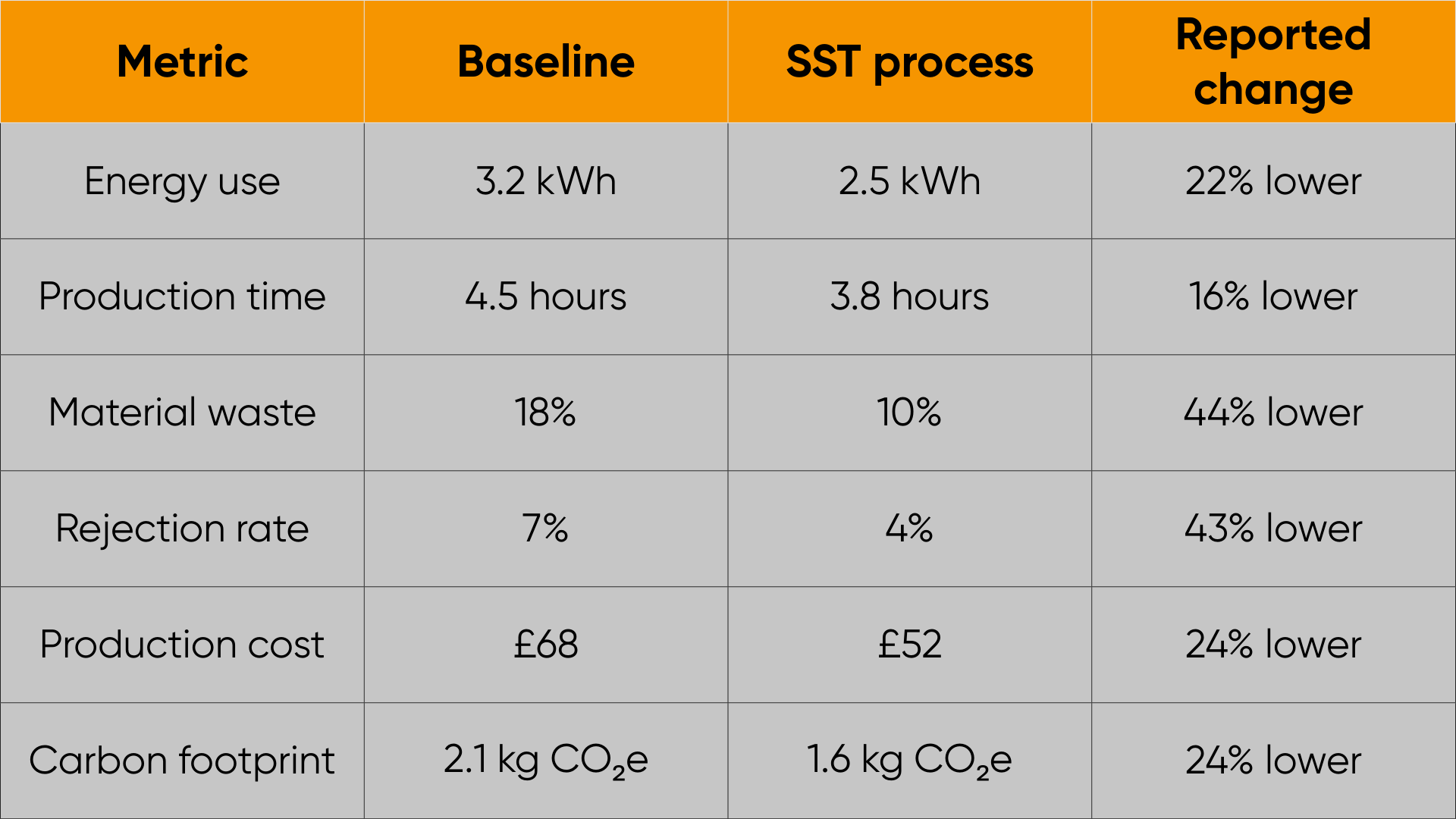
The study also reported a rise in Gross Value Added from £187,500 to £225,000, an increase of £37,500, and the creation of one full-time technical role.
From evidence to a new product line
The project gave Zirclab a new quantitative framework for measuring and improving the embodied energy of its manufacturing processes. This meant the company could move beyond broad sustainability claims and use comparable evidence to guide production decisions and communicate with prospective customers and funders.
Building on this evidence, Zirclab reported launching EcoZirc, a new line of dental prosthetics supported by independently informed environmental impact data. The company also reported a 25% improvement in conversion rates among environmentally conscious dental clinics following the launch.
Beyond the figures, Zirclab reported increased interest from other dental laboratories and a stronger position from which to pursue further funding. The company attributed this progress to the credibility created by the academic collaboration.
Benefits for research and teaching
For London South Bank University, the project generated applied research data on embodied energy in a specialised manufacturing process. The team developed a repeatable assessment approach with potential uses beyond dentistry and created material that can support teaching in sustainability and manufacturing.
The collaboration also strengthened the university’s relationship with an innovative business and gave the research and technical team practical experience of applying circular economy methods to live production data.
“Working with Zirclab gave us a rare opportunity to test our embodied energy assessment methodology against live production data across three genuinely different manufacturing techniques. Direct access to Zirclab’s facilities and process knowledge meant we could produce results that were rigorous enough to stand up academically and practical enough for the business to act on immediately.”
Academic Team, London South Bank University
Looking ahead
Zirclab plans to build on the research as it continues developing and commercialising its technology. Both partners intend to explore further collaboration with London South Bank University’s dental teaching team, additional research funding and a broader assessment of environmental factors beyond energy use.
London South Bank University also sees scope to explore sustainability measures designed specifically for the wider dental laboratory sector, helping other organisations make more informed comparisons between materials and manufacturing methods.
“The experience and support received were truly appreciated. Everyone involved in the project provided a good level of support and insight. Not only did we make progress with the project, but also with our connection with London South Bank University.”
Zirclab UK
About the programme
The BIG Growth Innovation Programme connects South London businesses with academic expertise from London South Bank University and partner universities, delivering tailored collaborative support to help businesses innovate and grow. The programme is funded through the UK Shared Prosperity Fund (UKSPF) by the Greater London Authority. The aim of the UKSPF was to improve pride in place and increase life chances across the UK by investing in communities and place, supporting local businesses, and developing people and skills.
If you'd like to collaborate with our experts, get in touch.